

Ferrule And Stop Set How To Use
We recently posted about a spectacular 3D-printer fire that was thankfully caught and extinguished before spreading to the hacker's house or injuring his family. Analyzing the remains of the printer, the hacker adamant that the burn was caused when a loose chow screw permit the extruder's heater cartridge fall out and impact the ABS fan shroud. It ran full-on and set things on fire.
A number of us take similar 3D printers, so the comments for this commodity were understandably lively, merely 1 annotate stood out past list a number of best practices for wiring, including the use of ferrules. In particular, many 3D printers connect the heated bed, which draws a lot of current, with screw terminals to the motherboard. While non the cause of the fire in the original post, melted terminal blocks are a common complaint with many DIY 3D printer kits, and one reason is that simply jamming thick stranded wire into a screw terminal and hoping for the all-time tin effect in increased resistance, and oestrus, at the articulation. In such situations, the absolutely right thing to exercise is to crimp on a ferrule. So allow's talk about that.
A Serial of Tubes
So what is a ferrule anyway? In general, any kind of band or clamp that'southward used to adhere, reinforce, or secure objects to each other. That's a broad definition that covers everything from the aglets applied to shoelace ends to forbid unraveling to the stout metal clamps used to connect wire ropes together. But in the world of electric wiring, ferrules have a more specific definition, and very different purposes than ferrules used for purely mechanical applications.
An electrical wiring ferrule is a soft metal tube that is crimped onto the end of a stranded wire to meliorate the wire's connection characteristics. Most ferrules are made of copper, which is usually plated with tin. The ferrule is sized for a specific gauge of wire, both in terms of its diameter and its length. A ferrule is not just a uncomplicated cylinder, though — information technology has a lip or flare formed into one end that serves to collect and consolidate the private strands of the wire as they are inserted into the ferruule.
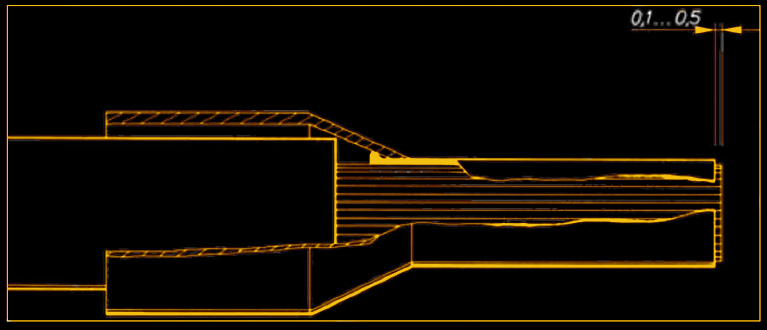
The flare in most ferrules is non immediately apparent because it'due south usually encased in a conical plastic cable entry sleeve. This sleeve acts equally a transition between the insulation of the wire and the ferrule itself, and also serves to corral all those loose strands into the lumen of the ferrule. Unlike in more traditional crimp connections, the plastic sleeve of a ferrule is not compressed during installation. It stays intact around the insulation, and provides some measure out of strain relief after installation by moving the bend radius of the wire away from the terminate of the insulation. Most ferrule sleeves are colour coded for wire size in the DIN 46228 standard, which confusingly has two different codes, French and German language, for the same cross-sectional area in foursquare millimeters.
Making Stranded Wire Solid
If it sounds like ferrules are more a European thing than an American i, that'southward with proficient reason. In order to get CE certification, electric equipment must terminate stranded wire inbound a screw or leap terminal with ferrules. There's no such regulation in the United states of america, and so it'southward non common to see ferrules used in American equipment. But ferrules have specific advantages that are difficult to deny, and their adoption appears to exist spreading because they brand good engineering sense.
To sympathize the principle, clip a small piece of insulated stranded wire of whatsoever guess. Stranded wire is flexible, which is i of the reasons it'southward used rather than solid wire in mobile applications and where vibration can occur. Merely it's withal somewhat stiff thank you in part to the insulation, which wraps the strands of the usher, keeps them all in intimate contact, and maintains the twist, or lay, of the separate strands. Now strip off a chip of insulation from one cease. You lot'll discover that in nigh cases, the lay of the strands is at least partially disturbed — they untwist a petty. Strip off more than insulation and the strands get more and more separated. Take off all the insulation and the conductor will lose all structural integrity, falling into individual strands.
This is the essential trouble that ferrules solve: they maintain the close association of strands in the conductor afterwards the wire has been stripped and allow the connection to deport its total rated electric current. Without ferrules, stripped stranded wires compressed in screw terminals tend to splay apart, reducing the number of individual strands that are in firm contact with the terminal. The resistance of such terminations is much higher than properly ferruled connections.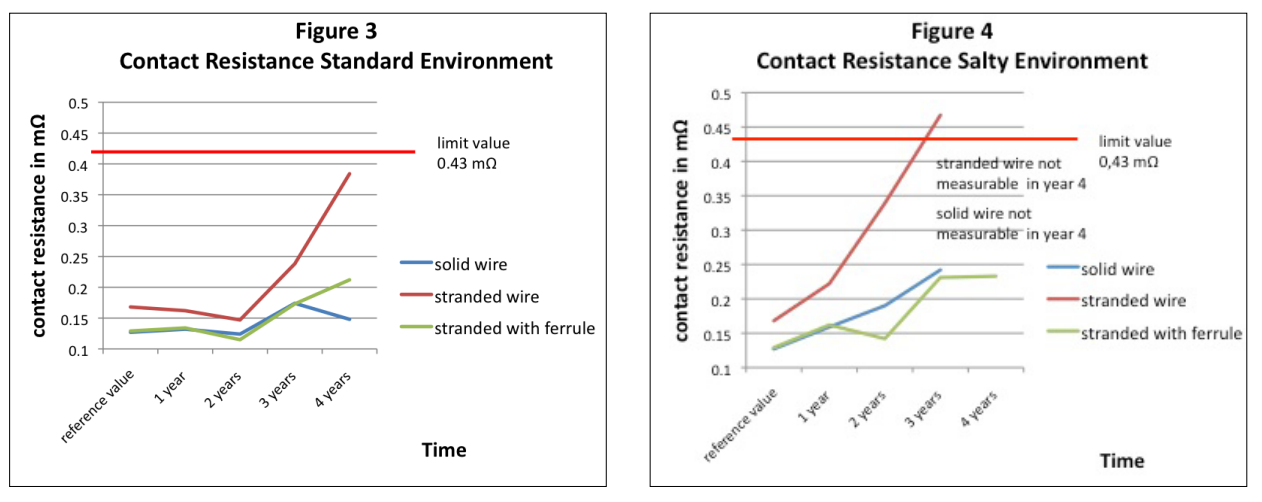 Stranded wires with ferrules perform much meliorate than without them. Source: Weidmüller Interface GmbH & Co. KG
Squeezing Your Issues Away
There's more than to a ferruled connection than reduced resistance, though. Like other crimped connections, the strands within a properly applied ferrule undergo tremendous pressure, in the process stretching axially and deforming radially. The stretching action tends to disrupt and readapt surface oxidation on the strands, while the radial pinch tends to remove the air spaces between the strands. These tend to make the crimped connectedness better at resisting oxidation than uncrimped wire, increasing the longevity of the connection.
So are ferrules the manner to go for the habitation gamer? On the whole, I'd say yep. Ferrules have obvious advantages over plain stranded wire, and in loftier-current applications, I would insist on using them with screw terminals or anywhere that the strain relief into the shielding is helpful. Plus, they lend a clean, professional look to a project, so even if the application is not-critical, I tend to include them on my stranded wire connections. It's not without its cost to tool up for ferrules, of grade, only at $30 for a kit with an assortment of ferrules and a proper ratcheting crimp tool, information technology'due south not besides bad.
Thanks to [NobodyInParticular] for suggesting this story.
[Featued images: KNIPEX, Ferrules Straight]

Ferrule And Stop Set How To Use,
Source: https://hackaday.com/2018/04/12/to-ferrule-or-not-to-ferrule/
Posted by: wetzeltiledgets80.blogspot.com
0 Response to "Ferrule And Stop Set How To Use"
Post a Comment